Drought and Food Availability in Southwest Us Peer Review

Economic and Ecological Impacts of Increased Drought Frequency in the Edwards Aquifer
i
Department of Public Finance, School of Economics, Xiamen University, Xiamen 361005, Communist china
2
Department of Agricultural Economics, Texas A&M University, Higher Station, TX 77840, U.s.a.
*
Author to whom correspondence should exist addressed.
Received: 13 Nov 2019 / Revised: 7 December 2019 / Accepted: xviii December 2019 / Published: 20 December 2019
Abstract
This paper examines how increased drought frequency impacts h2o management in arid region, namely the Edwards Aquifer (EA) region of Texas. Specifically, we examine effects on the municipal, industrial, and agricultural water utilize; country allocation; endangered species supporting springflows and welfare. We observe that increases in drought frequency causes agriculture to reduce irrigation moving country into grassland for livestock with a net income loss. This likewise increases h2o transfer from irrigation uses to municipal and industrial uses. Additionally, we notice that regional springflows and well elevation will decline under more frequent drought condition, which implicates the importance of pumping limits and/or minimum springflow limits. Such developments take ecological implications and the springflows support endangered species and a switch from irrigated state use to grasslands would affect the regional ecological mix.
i. Introduction
The Edwards Aquifer (EA) provides high-quality water to more than than 2 meg people in the Texas counties of Kinney, Uvalde, Medina, Bexar, Comal, and Hays and supplies a considerable proportion of the base flow to the Guadalupe River. The EA water supports pumping use by irrigated cropping, households, businesses, industries, and users of spring-fed rivers. Aquifer fed springs provide important habitat for endangered species [1]. The EA h2o supply relies on precipitation-based recharge, which is highly influenced past weather and adversely afflicted by drought.
Climate alter may alter drought frequency and affect water use in the EA region. The Special Report on Managing the Risks of Extreme Events and Disasters to Advance Climatic change Adaptation (SREX) report of the Intergovernmental Panel on Climate change (IPCC) shows that changing climate can issue in alterations in the frequency, duration, and intensity of farthermost atmospheric condition events [ii]. More frequent and severe droughts are expected across many regions in the 21st century [iii,4,5,vi]. Irresolute climate is projected to reduce groundwater resources in nigh dry out subtropical regions, which may intensify h2o employ competition among sectors [7]. Texas has been projected to experience more frequent future drought [viii,9]. Increases in the drought frequency or average temperature along with decreases in rainfall all increment water demand but lower water availability.
Recent climatic trends may increase water and drought concerns. For case, the 2000'southward was the warmest decade on record [10], and 2011 was the strongest La Niña twelvemonth on record [xi]. Additionally, La Niña years are associated with low EA region recharge and drought [12]. Texas and the EA region take been facing drought conditions for the final few years, and 2011 was the nigh severe, with 88% of the entire country under exceptional drought conditions in September/October [13].
This written report examines the implications of increasing drought frequency on the EA region in terms of water availability, water utilize, agricultural product, land allotment, springflow, welfare, and ecology.
2. Background and Literature Review
ii.i. Edwards Aquifer
The EA is a crucial h2o source for municipal, industrial, and agricultural pumping users and supports the springflow needs of endangered species in south-central Texas. Balancing h2o allocation between pumping users and springflows has been debated for over two decades. EA recharge depends on rainfall and is highly variable. Recharge has varied widely: in 1956, information technology was 43.7 thousand acre-feet with precipitation of eleven.22 inches; and in 1992, the recharge reached two,176.1 thousand acre-feet with 38.31 inches. Pregnant droughts in the 1950s resulted in the cessation of flows in the Comal Springs, which led to the extinction of the fountain darter population [14]. Habitat for several endangered species is supported by springflows [xv]. The aquifer is karstic and does non retain water equally it barbarous greatly in the twelvemonth afterward the large recharge events [sixteen].
In Texas, surface water is governed by the prior appropriation doctrine while groundwater is governed by the rule of capture, which discourages the conjunctive use of groundwater and surface h2o. The groundwater utilize can be regulated by the Texas Supreme Court with that regulation subjected to compensation [14]. In early 1993, springflow protection was ordered by a federal courtroom based on a suit under the endangered species act. Then, the Texas legislature passed Texas Senate Beak 1477 (SB1477), which created the Edwards Aquifer Authority (EAA) and directed the EAA to manage the aquifer withdrawals. SB1477 required the maximum annual book of water pumped to be 400 thousand acre-anxiety by 2008 and mandated establishment of h2o rights. Furthermore, regional water managers, in social club to protect endangered species, introduced springflow and aquifer peak-dependent management. The Critical Period Management Plan (CPMP) is currently used for direction and makes pumping dependent on aquifer elevation and springflow. For instance, the CPMP requires a permitted withdrawal reduction of xx% when the x-day average of the charge per unit of menstruation of the Comal Springs is beneath 225 cubic feet per 2d (cfs).
ii.two. Literature Review
The U.s. southwest is projected to have more than frequent multi-year droughts [17,18] and reduced cool season precipitation [19]. Diffenbaugh et al. [20] concluded that global warming was increasing drought probability. Sheffield and Wood [9] projected that cardinal Due north American long-term droughts would become three times more common. Such developments stress the regional water situation and enhance h2o competition.
Conjunctive utilise of ground and surface water is a common strategy for managing drought in arid regions [21,22]. Daneshmand et al. [23] applied an integrated hydrologic, socio-economic, and ecology approach to assess conjunctive water use during drought in the Zayandehrood water basin in Iran, and found that conjunctive employ would preserve water supply reductions to nether 10% of the irrigation demand during a drought. Pulido-Velazquez et al. [24] analyzed the economical and reliability benefits from dissimilar conjunctive uses of surface and groundwater in southern California and noted that conjunctive operations could be adjusted in anticipation of drought and wet years to reduce h2o scarcity and scarcity price.
On an aquifer scale, Castaño et al. [25] used a groundwater flow model to evaluate the impacts of drought cycles (from 1980 to 2008) on the evolution of groundwater reserves in the Mancha oriental aquifer arrangement (SE Espana), and their results showed that if the drought was to persist, the costs from the storage deficit ranged from €21.7 million to €34.9 million. Gold and Johnson [26] developed an economic model of production and temporal allocation to estimate producer and hydrologic impacts over a threescore-year fourth dimension horizon in the Ogallala aquifer area in northwest Kansas, and plant that express irrigation was the least costly method of conserving water. The importance of groundwater management under drought conditions has also been found along the Changjiang River, China [27], South Africa [28], and northwestern People's republic of bangladesh [29].
Several studies take been conducted on the EA. Scanlon et al. [30] used the equivalent porous media models to simulate groundwater flow in Barton Springs Edwards aquifer. Loaiciga et al. [31] scaled historical recharge data to ii×COtwo conditions to set upwards recharge scenario and found that the water resources of the EA could be severely impacted under warmer climate scenario if aquifer recharge and pumping strategies were non properly considered. McCarl et al. [32] used the Edwards Aquifer Simulation Model (EDSIM) to examine the economical dimensions of water management policy on the EA region. EDSIM is an economic and hydrological simulation model that depicts water allocation, agriculture, municipal/industrial (One thousand&I) use, springflow and pumping lifts in the EA, and it depicts the h2o supply and use across ix states defined by the probability distribution of recharge. These states represent the full spectrum of recharge possibilities, and lower recharge years are used in this study to correspond drought. The drought defined here is meteorological since recharge in a karst aquifer correlates well with rainfall variation [16]. After, EDSIM has been used to study climate change effects [33], regional h2o planning [34], El Niño-Southern Oscillation (ENSO) effects [12], and height dependent management [35]. To date, EA studies have not considered the possible discontinuation of cropping with the conversion of agronomical land to livestock pasture. Use of integrated crop-livestock systems represents a method of adapting to increased drought [36,37]. A number of studies have been performed on the economical impacts of increased drought occurrence, with well-nigh studies focused on surface water [38,39,xl].
To behave our research, we modified the EDSIM model used past McCarl and team [12,32,33,34,35] adding livestock production, land conversion to grassland from irrigated cropping in turn supporting livestock product and used information technology under scenarios exhibiting an increased probability of drought occurrences.
3. Modeling Framework
The chief model used here is the EDSIM, which simulates the agronomical and municipal and industrial (M&I) water uses, compares irrigated versus dryland cropping, and considers the livestock herd size, pumping toll and springflow. This model optimizes the consumers' and producers' surpluses past simulating the economical allocation of land and water in a perfectly competitive economy (equally discussed in McCarl and Spreen [41] and Lambert et al. [42]) subject to legislatively imposed pumping limits.
EDSIM is a two-stage stochastic model [43] with nine states of nature representing different recharge amounts and climate conditions. At the first stage, the choice of adult irrigated land, country conversion between irrigated state and grassland and dryland, crop mix and livestock herd size is decided independently of recharge state. At the second stage, the recharge land is taken into account. The crop irrigation strategy, ingather harvesting, livestock feeding, and M&I water use tin can be adjusted when the recharge state is known. The irrigation strategy is decided with cognition of the recharge state, yield consequences, pumping lift, and ingather mix. Livestock product is not directly affected by the water availability. Livestock competes with crops as more than livestock land arises simply through country conversion betwixt cropland and grassland. Water use in the M&I sectors is dependent on the recharge state plus pumping lift. Pumping lift is a function of aquifer elevation which in plow is a function of initial aquifer level, recharge amount and pumping utilise. Two aquifer pools are modeled one in the east and one in the westward. The volume of springflow is adamant by initial aquifer level, recharge amount and pumping by agronomical and non-agricultural sectors.
A mathematical presentation on the model is given in Appendix A.
iv. Scenario Setup
The analysis on the effects of increasing drought was conducted past running the model under culling scenarios. These scenarios contained changes in the probability of drought occurrence plus changes with and without pumping and springflow limits likewise as at dissimilar times considering population growth. The specific scenarios are divers in Table ane.
-
Under the increased drought frequency scenarios, the probability of drought events with lower recharge level in the 78-year (year 1934–2011) distribution was increased. Co-ordinate to the recent work by Aryal et al. [8], a 20% increment in drought frequency is projected. Hence, we followed Adamson et al. [38] and increased the probability of drought years so they were some 20% larger while decreasing the probability of the residual of the years so it was some 20% smaller, with the probability of normal years unchanged.
-
A maximum pumping limit of 400 thousand acre-feet was considered based on SB1477. Another scenario of a minimum springflow of 225 cfs was introduced to take into account endangered species protection. This is essentially a strategy currently being utilized in the region. Additionally, we examined a maximum lower pumping limit of 375 grand acre-feet to investigate how it performed under the increased drought.
-
We considered M&I demand growth stimulated by population growth in the form of a 10% increment in h2o demand by the Grand&I sectors.
5. Data Specification
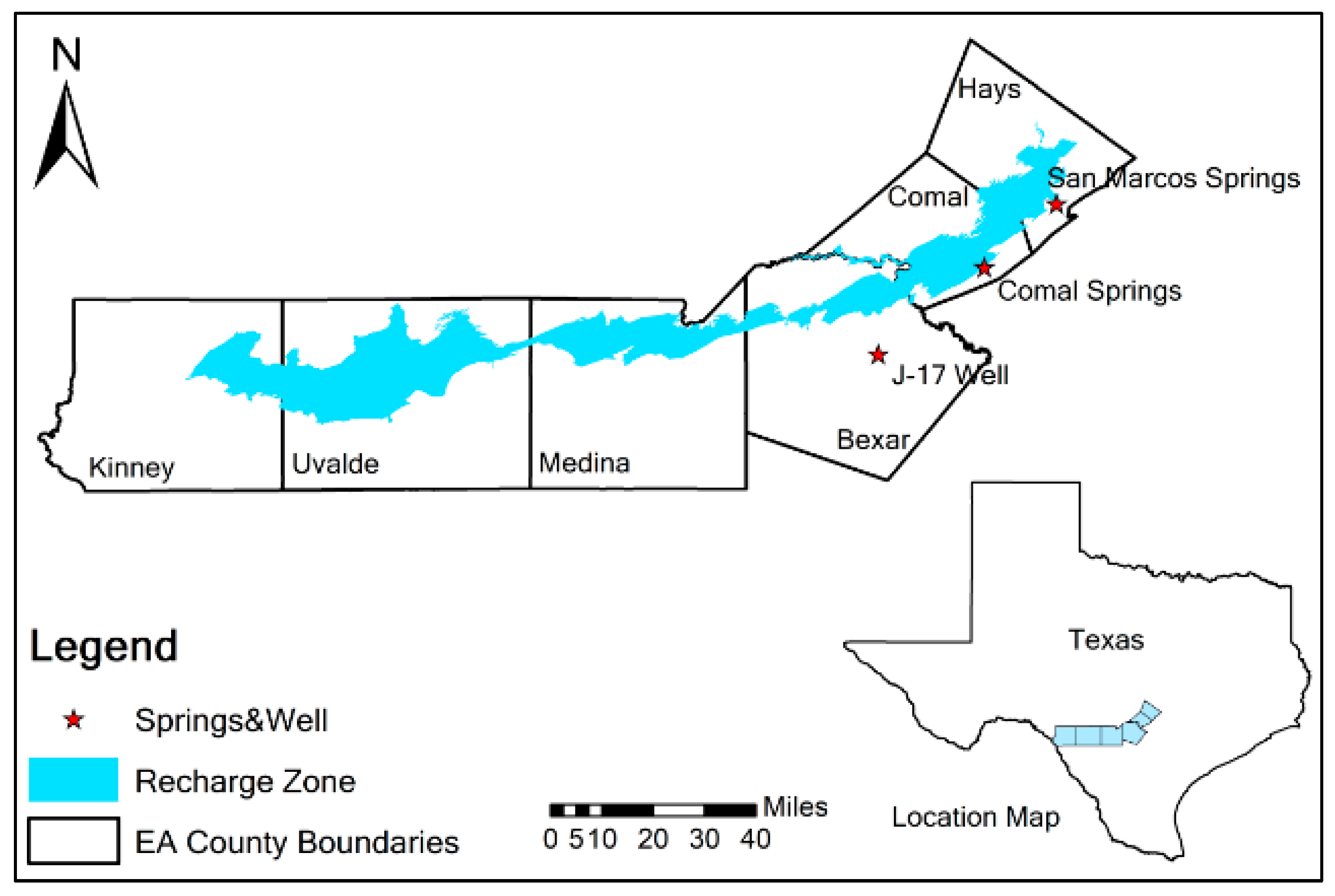
EDSIM depicts the activity in parts of half dozen counties that establish the recharge and pumping use zone of the EA. The counties are Kinney, Uvalde, Medina, Bexar, Comal, and Hays. Study area is shown in Figure 1. Data are by and large at the county level. When county-level data were unavailable, then district data were used mainly for ingather and livestock production budget information. Nosotros discussed the basics of the data beneath with details provided in Ding [44].
v.1. Crop and Livestock Information
Ingather budget data were fatigued from the annual budgets produced past the Texas A&Thou AgriLife Extension Service. These budget data include crop yield, price, and input cost with twelvemonth 2011 beingness used. Crop mix data were drawn from Quick Stats, National Agronomical Statistics Services (NASS) and the Census of Agronomics. The mix data included the harvested acreage by ingather.
The livestock budgets as well came from the Texas A&M Agrilife Extension Service although due to data availability nosotros had used information from an adjacent region [45]. The budgets were defined on an animate being unit (AU) footing. One head of cattle was treated as one creature unit of measurement, and six head of goats and five head of sheep were also considered on i animal unit [46]. The internet benefit per AU was specified as the returns above direct expenses less the toll of grassland utilise per acre per AU. Livestock mix were defined based on inventory which were collected from Quick Stats, NASS.
five.2. Recharge Information and States of Nature
Following the original EDSIM, there are nine recharge states that range from heavily dry to heavily wet based on regional US geological survey data as reported by the EAA. To form these, nosotros clustered the historical annual recharge information into the nine states of nature. Table 2 shows the recharge states and the corresponding typical conditions years clustered into each. The probability of a recharge country was divers as the relative incidence of a conditions years falling into that state thus, since 3 years fell into the 'heavily dry out' category, nosotros used three divided past 78 as the probability. Based on the typical weather years, we obtained the probability distribution of the recharge country (see Tabular array 2). Following Cai [47], the dry years in Table 2 were classified as drought years; normal as normal years, and the remainder as wet years. Hence, the probabilities for drought, normal, and wet years were 0.1923, 0.4615, and 0.3462, respectively. In the scenario of increased drought frequency, the summed probability of drought years increased from 0.1923 to 0.3923 by essentially doubling those probabilities and the summed probability of wet years were decreased from 0.3462 to 0.1362. The probability of normal years was not changed. The drought frequency is simply defined as the summed probability of drought years without considering the temporal or seasonal nature of droughts.
5.3. Land Availability
Land availability information were obtained from the 2007 Census of Agronomics. Cropland was categorized as irrigated land and dryland, and irrigated land was further classified every bit furrow and sprinkler land. 3 pumping elevator zones were considered here to reflect initial depth to water. The availability of sprinkler state in each lift zone was calculated based on the zonal percentage of total pumping use, and and so the available furrow land in each zone was the difference between the irrigated country in each zone and the estimated sprinkler land. As in McCarl et al. [32], dryland was initially prepare every bit zero because we focused on studying land utilize and conversion.
Grassland apply was added to the EDSIM. We causeless that all of the grassland is non-irrigated [45]. Furrow or sprinkler country tin be converted to dryland or grassland.
5.4. Municipal and Industrial Water Usage
H2o usage data in the One thousand&I sectors were based on the Hydrologic Information Report from the EAA website [48]. The water usage data were annual, although we needed monthly data for the EDSIM. Therefore, the 2011 monthly Thou&I h2o usage information were calculated based on the monthly distribution of h2o use in 1996. The elasticity of municipal need was from Griffin and Chang [49], while the elasticity of industrial demand came from Renzetti [50].
5.five. Linkages between Water Usage, Bound Flows, and Aquifer Summit
A disquisitional part of the report involved linking the spring flow and aquifer elevation to h2o usage. This was washed using functions estimated by Keplinger and McCarl [51] that related jump menstruation and ending elevation levels to the initial water level, pumping, and recharge level past states of nature.
6. Model Results and Discussion
In doing our analysis, we first solved the model with and without increasing the drought frequency and reported the results on welfare, land utilise, water apply, springflow, and ending peak under various scenarios. Later we examined how welfare changes under different degrees of increased drought incidence.
6.1. Welfare Effects
Tabular array 3 presents the welfare effects with and without increased drought frequency. First, nosotros considered the base results for no changes in drought probability. Under 2011 conditions, the crop income is $211.75 million and livestock income is $54.fourscore million. When a 400 k acre-feet limit (2011Base400) is considered, the results prove a ingather income reduction of $8.24 meg per yr, which is iii.89% below the baseline income level. Income from livestock production increases by $2.38 million, which is 4.34% of the base year income. This reflects state moving out of irrigation and into grassland. The loss in M&I surplus is less than 0.1% of the baseline surplus. The percentage change in M&I surplus is pocket-size considering the water demand curve in these ii sectors is fairly inelastic with water values being substantially higher.
If the pumping limit is stricter, e.g., 375 thousand acre-feet, and then the welfare changes in each sector are larger. Compared with the effects under pumping limits of 400 yard acre-anxiety and 375 yard acre-feet, the effects of a springflow limit of 225 cfs on welfare are smaller because the total water employ under this limit is greater than 400 thousand acre-feet (come across Table 5). The springflow limit is not equally strict in limiting the h2o employ in the EA region because the springflow limit allows more water use in wet years and in fact is the fashion that the aquifer is managed currently.
Moreover, if the M&I water demand increases by 10%, which is observed in the 10Base400, 10Base375 and 10Base+Spring225 scenarios, ingather income shows greater decreases while livestock income increases slightly; still, the Yard&I surplus increases profoundly considering the water demand curves for these sectors shift outward.
A drought probability increase of 0.2 yields more extreme results. If a pumping limit is not considered, then increased drought will lead to a cropping loss of $6.88 1000000 and a full surplus loss of $2.40 million with water flowing to M&I interests. These losses are larger under pumping limits, and they too significantly reduce springflow, which volition exist shown in a subsequently hydrologic section. Under a 400 thou acre-feet pumping limit, additional frequent droughts will crusade a greater cropping loss of $6.xiv meg. Income from the livestock sector decreases slightly, whereas the M&I surplus increases because water flows to more than valued users. Increased drought also results in a full welfare loss of $one.75 meg per year. When stricter pumping limits are imposed, cropping losses due to more than frequent droughts are lower. For example, under 375 yard acre-feet pumping limit (2011Base375), increased drought will cause cropping losses of $5.98 million, whereas additional frequent droughts under 400 chiliad acre-feet pumping limit will cause ingather losses of $6.14 million.
As water demand in the M&I sectors increases and lower pumping limits are imposed, then cropping income declines more than and livestock income increases. If the M&I h2o demand increases past 10%, more frequent drought volition increase the competition for water allocation among irrigation, municipal, and industrial users. Boosted water flows to the M&I sectors leads to more losses in cropping income. For example, under a minimum springflow of 225 cfs (10Base+Spring225), increased drought causes a cropping loss of $8.42 one thousand thousand per year and livestock income increase of $0.68 million per twelvemonth.
half-dozen.2. State Apply
Data in Table 4 portray land apply impacts with and without altered drought frequency. There is no irrigated land converted to grassland when no pumping limits are imposed. For cases of no changes in drought incidence, the lower pumping limit of 400 thousand acre-anxiety results in land conversion of 10.54 thousand acres from furrow land to grassland and 20.65 k acres from sprinkler land to grassland. When much stricter pumping limits are imposed (2011Base375), more furrow land and sprinkler land are converted to grassland. The impact from imposing a minimum springflow constraint is smaller than that from a pumping limit for the same reason provided above. The impacts on land use will be greater if there is an increment in M&I water demand of x%.
When the drought probability increases past 0.2 under the 2011Base400 scenario, the conversion of furrow state to grassland becomes 0 acres, whereas additional frequent droughts causes more conversion of eleven.52 thousand acres from sprinkler land to grassland. Increased land conversion of sprinkler land to grassland also occurs under the other scenarios. For example, under the scenario of 2011Base375, more frequent droughts reduce the sprinkler land by 16.48 thousand acres via the conversion to grassland. Furthermore, the drought touch on land use change increases in severity when the One thousand&I water demand increases by x%, which too increases the conversion of irrigated land to grassland. For example, a comparison of scenarios 10Base400 with and without increasing drought frequency shows that when drought becomes more frequent, additional sprinkler land is converted to grassland while less furrow country is converted to grassland. Land transfers increase when water allotment becomes more competitive, i.e., under a pumping limit of 375 k acre-feet.
six.3. H2o Use
Table five shows water utilise with and without increases in drought frequency. When droughts do not increase and the total water withdrawn from the aquifer is restricted to 400 thousand acre-anxiety, and so the total water usage is reduced past 102.17 thousand acre-feet, with 89.88% of the reduction from agriculture, primarily in the east region (see Figure 2). When springflow is limited to be greater than 225 cfs, due east agricultural water use as well decreases considerably. A 10% increase in K&I h2o demand farther reduces the water usage by agriculture.
Now, we consider the effect of increased drought on water use. When the total water pumping is limited to 400 thousand acre-feet, more than frequent droughts will crusade a further reduction of agricultural h2o use of 2,160 acre-feet and a total water usage decrease of 560 acre-feet. If the total water pumped from the aquifer is restricted to 375 thousand acre-feet, and so agricultural water utilize further declines by 1,480 acre-feet and the full water usage is reduced past 100 acre-feet. Even so, when springflow limit of 225 cfs is imposed, more than frequent droughts will cause more reduction in agronomical water use. The above comparison indicates that stricter pumping constraints lower the impact of increased drought on water allocation because ample h2o is frequently observed. Furthermore, drought impacts on irrigation water utilize increment if the Thou&I h2o demand increases by 10%, with the impacts mainly on eastern region irrigation water utilise (see Figure 2).
6.4. Hydrologic Impacts
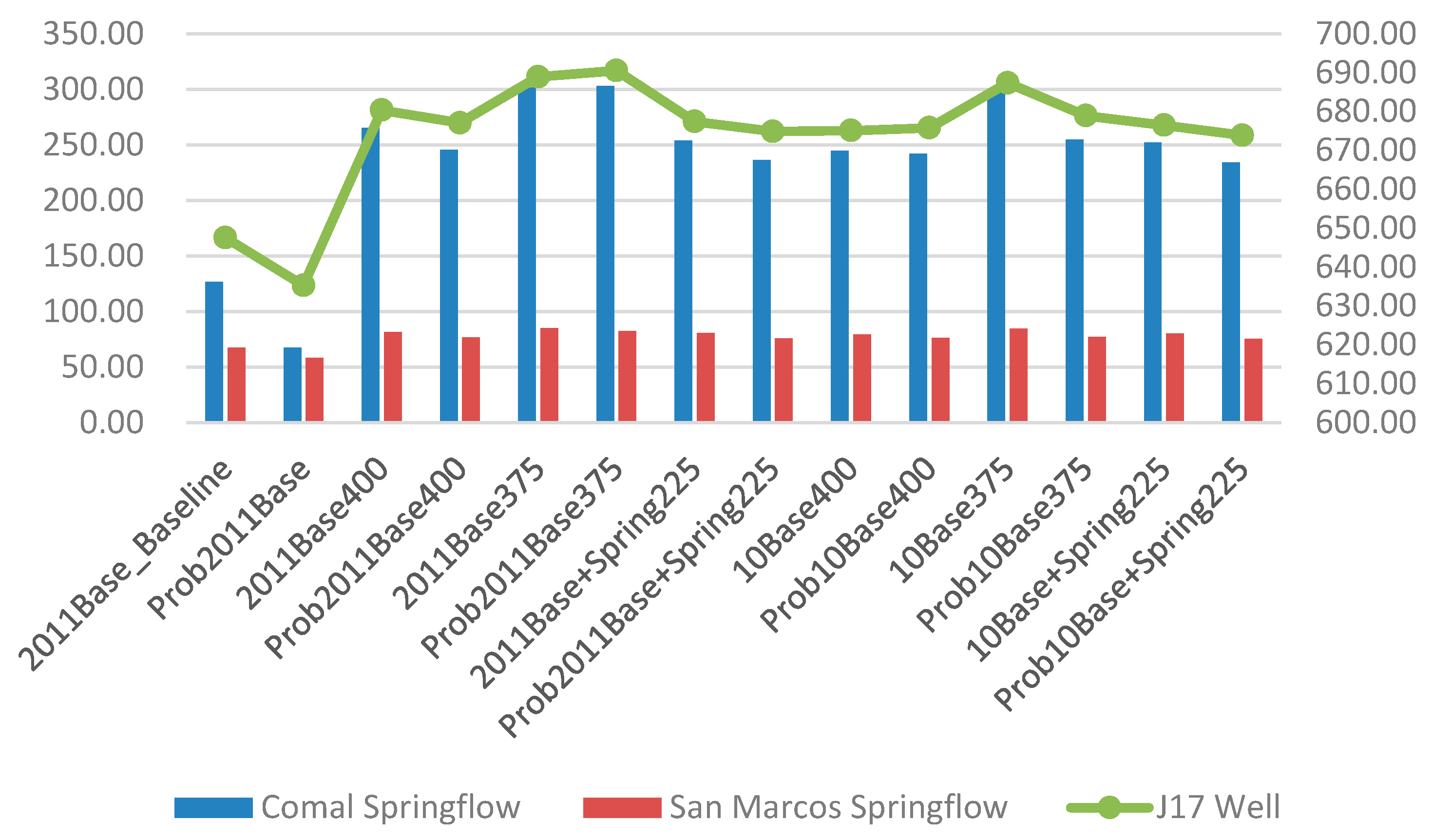
Effigy 3 presents a comparison of the hydrologic impacts. When the drought probability is not changed, both the pumping and minimum springflow limits increase the springflow in both Comal Spring and San Marcos Spring, and the J17 well h2o superlative every bit well. The lower pumping limit (375 thousand acre-anxiety) increases the springflow and the J17 well water peak the most. If the M&I water demand keeps unchanged, the 400 pumping limit protects the springflow and well meridian better than does the springflow restriction. All the same, when the Thousand&I water demand goes upwards by 10%, the role of springflow brake is bigger than 400 pumping limit.
When the drought probability increases past 0.2, the springflow and the J17 well elevation are reduced. If there are no restrictions on pumping or springflow, increased drought volition crusade the springflow and J17 well terminate top decline greatly, which further emphasizes the importance of pumping limits and/or minimum springflow limits. Again, the impacts are smaller with a pumping restriction of 375 thousand acre-feet because this limit provide a condom margin. Similar results are observed when the M&I h2o need increases. Note hither in the case if both the 1000&I h2o need and drought frequency increase, pumping limits can help better protect springflow and well tiptop than springflow restriction, probably because pumping limits tin can overall plan the use of water resources when water utilize competition is stricter.
6.five. Comparison of the Impacts under Different Changes in Drought Probability
Table half-dozen reports the impacts under dissimilar changes in drought frequency. Hither nosotros consider drought probability increment from 0.1 to 0.3, which holds the probability of normal years unchanged and let the drought probability increase and the moisture probability decrease in the relative amount. According to Zhao et al. [52], they projected that the probability distribution function (pdf) of agricultural drought would become flatter. We as well consider a scenario that drought probability increases 0.2 and normal year probability and wet probability decreases 0.1, respectively. The outset four lines of Tabular array six nowadays the boilerplate economic benefit under different degrees of drought frequency change. The baseline presents the case when the full water pumped is limited to 400 thousand acre-feet. In turn, if the probability of drought increases by 0.1, then cropping will endure a loss of $2.97 million. Moreover, the income from livestock production will decrease slightly, the M&I surplus volition increase past $ii.13 million, and increased drought will cause a total surplus loss of $1.03 million per twelvemonth.
When droughts go more frequent, the cropping loss volition be greater and the acreage of irrigated country will subtract. When the drought probability increases past 0.1, additional irrigated farming is conducted; however, as droughts become more than frequent, irrigated acreage decreases and more land is converted to grassland. When grassland acreage increases, livestock income increases as well. In terms of water use and hydrologic impact, water reductions primarily occur in the irrigation apply. Additionally, as droughts go more frequent, the springflow in both of the springs and the J17 well water elevation are reduced. More frequent droughts reduce the springflow, and stricter pumping limits or springflow restrictions would exist required to maintain current springflow levels and protect jump-supported endangered species.
7. Conclusions
EA recharge mainly relies on rainfall, which would be negatively affected by the increased incidence of drought proved by a number of studies in the IPCC [2]. In particular, drought frequency is predicted to increase in the southwestern U.S., where the EA is located [17,18]. We find that such developments would shift h2o from cropping to M&I interests with decreases in cropping income, increases in livestock income and non much result on the M&I welfare. Nosotros find that under a pumping limit of 400 thousand acre-anxiety, an increased drought frequency will result in a regional cropping loss of $6.fourteen million per year, with yet more water reallocated to G&I interests. Stricter pumping limitations, such equally a 375 thousand acre-anxiety pumping limit, aid alleviate the cropping losses under the increased drought scenario principally due to lower pump lifts.
Nosotros also found that more than frequent droughts volition increase country transfers from irrigated country to grassland and livestock uses, while decreasing springflows in both Comal Spring and San Marcos Spring. To preserve the endangered species habitat surrounding the springs, lower maximum pumping limits or minimum springflow restrictions are required. In that location are also ecological implications of this in that there are several endangered species whose habitat is supplied by the springflow plus a change from irrigated agriculture to grassland-based livestock would certainly bring about a number of other ecological alterations.
Author Contributions
Conceptualization, B.A.M.; methodology, B.A.M. and J.D.; software, J.D.; validation, J.D.; formal analysis, J.D.; investigation, J.D.; resources, B.A.M. and J.D.; data curation, J.D.; writing—original typhoon grooming, J.D.; writing—review and editing, B.A.M. and J.D.; visualization, J.D.; supervision, B.A.M.; project administration, J.D.; funding conquering, B.A.Grand. and J.D. All authors have read and agreed to the published version of the manuscript.
Funding
This research was partially funded by the NOAA—Climate Programs Office—Sectoral Applications Research Programme under grant NA12OAR4310097 and the U.South. Department of Agriculture—National Institute of Food and Agriculture under grant 2011-67003-30213 in the NSF—USDA—DOE World System Modelling Plan. In addition while the majority of this work was done at Texas A&One thousand Academy, some was likewise done at Xiamen University with funding provided past the Chinese Central Research Funds for the Central Universities nether grant 20720151281. We acknowledge the support of both institutions.
Acknowledgments
We thank David Anderson and Chengcheng Fei at Texas A&K University for their helpful comments. 2 bearding referees provided comments that improved the initial version of this newspaper.
Conflicts of Involvement
The authors declare no conflict of interest.
Appendix A. EDSIM Model Concept and Structure
Before presenting the fundamental algebraic structure of the EDSIM, we will overview its theoretical structure. In brief, EDSIM is a price endogenous mathematical program that tin can be represented past the post-obit Equation (A1),
where
and
are the quantities demanded and supplied, respectively;
is the inverse demand curve that provides the demand toll every bit a part of the quantity demanded; and
is the changed supply curve that provides the supply price as a function of the quantity supplied. The objective function is the sum of the consumers' plus producers' surplus in the EA region field of study to hydrological, state, and institutional constraints. The model is stochastic facing nine states of nature where the model must make sure choices (crop mix, livestock herd size, land transformation) before knowing the state of nature and so others dependent on the country of nature (irrigation strategy, crop harvest and sale, livestock sale, municipal and industrial water consumption). The first-order weather of such a model render the model solution equally a simulation of what would happen under a perfectly competitive regional allocation of resources [41,42].
Appendix A.1. Objective Function
The objective function depicts the expected consumers' plus producers' surpluses. In this example due to the extremely small share of US production in the region fixed prices are used for agricultural commodities. Consequently, the objective office maximizes the revenue from crop and livestock production plus the expanse under the Yard&I demand curves less the costs of ingather production, livestock product, and development of irrigated land and costs of lift-dependent pumping. Also, stochastics are present with some terms independent of country of nature and other terms dependent. More precisely, the objective office is presented as follows, with variables in upper case and parameters in lower instance.
The kickoff part (first line) of Equation (A2) contains two costs and is independent of land of nature. One is the unit price of irrigation development (irrcost) by elevator zone (z) multiplied by the irrigated land developed (IRRLAND), the other is the cost of converting furrow land to sprinkler land (FURRTOSPK) in a canton (p) and lift zone (z).
The 2nd office of Equation (A2) in brackets is stochastic based on the recharge country (r) and is weighted by the probability (prob) of each state. The beginning ii lines depict the net acquirement from ingather yields, which is the crop revenue minus production costs per acre (irrincome and dryincome) multiplied by the acres produced (IRRPROD and DRYPROD) summed across each county (p), pumping zone (z), crop (c), recharge state (r), and irrigation strategy (s). The third line subtracts irrigation water pumping toll (the variable AGPUMPCOST) multiplied by water employ (AGWATER) past county (p) and lift zone (z) in month (m) under recharge country (r). Lines four and v stand for livestock product net revenue, which includes the livestock internet income (liveincome) multiplied past livestock raised (LIVEPROD) by livestock blazon (l), canton (p) and elevator zone (z) nether the recharge state (r). We also deducted the price of grassland maintenance (grasscost) times the grassland used (GRASSUSE) by county (p) and lift zone (z) and recharge state (r). The last three lines stand for the M&I benefits and costs of water pumping, which involves the area nether the M&I demand curves less pumping cost (a variable MIPUMPCOST) by county (p) under recharge state (r). The variables MUN and IND represent the amount of water demanded in the M&I sectors, respectively.
Appendix A.ii. Land Availability Constraint
Equation (A3) limits irrigated land use by crop (c) and irrigation strategy (south) in a lift zone (z) and county (p) under recharge state (r) (IRRPROD) to the total irrigated country (IRRLAND). The full irrigated land does not vary past recharge state, meaning that it is set before climate conditions are known, nevertheless, the irrigated land choice is in a recharge state dependent on the ingather use and irrigation strategy.
The initial availability of dryland is naught because we only examine initially irrigated land area. Equation (A4) requires that dryland use in a county (DRYPROD) does non exceed the country converted from irrigated state to dryland (IRRTODRY) by county and lift zone. Note that the dryland bachelor through conversion is the aforementioned across all recharge states, but the dryland use tin can vary by recharge land.
Equation (A5) balances the total initial irrigated land where state used in irrigated cropping (IRRLAND) plus the amount converted to dryland (IRRTODRY) or grassland (IRRTOGRS) cannot exceed the initial availability (irrlandavail) in a county and elevator zone. Note that the available converted land is the same across all recharge states.
Equation (A6) is the grassland availability constraint, which limits grassland use (GRASSUSE) to the initial grassland availability (grasslandavail) plus land transformed from irrigated land to grassland (IRRTOGRS) by county (p) and lift zone (z). Note that the available grassland is the same across all recharge states but the grassland utilise tin vary by recharge state. Equation (A7) restricts livestock production and grassland use past county (p) and elevator zone (z) under recharge state (r), where gr denotes the grazing rate, which is the amount of grassland required per animal unit.
Appendix A.3. Crop Mix Constraint
Following McCarl (1982), the ingather mix restriction requires that crop product is a convex combination of historical crop mixes, which is performed for irrigated land and dryland separately. Thus, irrigated state produced (IRRPROD) is a convex combination of historical irrigated crop mixes (irrmixdata) in terms of crops (c) and mix possibilities (10) in county (p) in Equation (A8). Similarly, dryland produced (DRYPROD) is a convex combination of historical dryland crop mixes (drymixdata) in Equation (A9). The dissever limits for irrigated land and dryland permit their acreage to vary independently every bit more than or less land is converted. A separate mix is allowed for each lift zone causing realistic crop mixes on each zone. The crop mix approach is used to make realistic crop mixes without modeling detailed resource resource allotment at the farm level [53].
Appendix A.4. Livestock Mix Restriction
Livestock mixes are also defined in Equation (A10). Livestock production (LIVEPROD) past livestock type for a county and zone under a recharge state is ready to exist a convex combination of historical observable livestock mixes (livemixdata) in terms of species. As argued by McCarl [53], this constraint can brand realistic livestock mixes without modeling the detailed resource resource allotment at the farm level.
Appendix A.five. Lift Dependent Pumping Toll
Equations (A11) and (A12) relate the pumping cost to aquifer lift which is determined past the side by side equation. The agricultural pumping toll per acre-foot of water for county, zone, and recharge state equals a stock-still pumping cost (agcpump) plus a variable pumping cost (agvpump) per foot of lift multiplied by the agricultural lift (AGLIFT). Similarly, the M&I pumping costs per acre-foot are similarly divers.
Appendix A.6. Aquifer Top Determination
The ending water elevation level of the EA is calculated via Equation (A13), which relates the ending water level to a regression-estimated function that was developed by Keplinger and McCarl [51]. Namely nosotros determine elevation every bit a function of monthly recharge level (rech), initial water level (INITWATER), and total h2o utilise. Total h2o usage is the sum of municipal (MUN), industrial (IND), and agricultural (AGWATER) water use.
In Equation (A13), rendint is the estimated intercept, rendr is the parameter of recharge, rende is the initial water parameter, and rendu is the parameter of total water utilize. The subscript w refers to the region where the elevation is calculated, and the subscript w2 is used to sum the water use beyond both the eastward and the west EA regions.
Appendix A.7. Springflow Equation
Springflow levels are defined in Equation (A14), which relates springflow level to a regression-estimated function again from Keplinger and McCarl [51]. That office relates monthly springflow by jump s to monthly recharge in previous part of year, initial h2o level, and total water utilize. Therein rsprnint is the estimated intercept, rsprnr is the parameter of recharge, rsprne is the initial h2o parameter, and rsprnu is the parameter of full water employ. Both subscripts m and m* refer to the month.
References
- EAA. 2018 Groundwater Discharge and Usage. Bachelor online: https://www.edwardsaquifer.org/wp-content/uploads/2019/08/2018-Discharge-Report.pdf (accessed on 19 December 2019).
- IPCC. Managing the Risks of Extreme Events and Disasters to Advance Climatic change Adaptation. In A Special Report of Working Groups I and II of the Intergovernmental Console on Climatic change; Field, C.B., Barros, V., Stocker, T.F., Qin, D., Dokken, D.J., Ebi, 1000.L., Mastrandrea, M.D., Mach, M.J., Plattner, G.-K., Allen, S.Yard., et al., Eds.; Cambridge University Press: Cambridge, UK; New York, NY, USA, 2012; pp. 25–231. [Google Scholar]
- Schwalm, C.R.; Anderegg, W.R.50.; Michalak, A.M.; Fisher, J.B.; Biondi, F.; Koch, G.; Litvak, M.; Ogle, Yard.; Shaw, J.D.; Wolf, A.; et al. Global Patterns of Drought Recovery. Nature 2017, 548, 202–205. [Google Scholar] [CrossRef] [PubMed]
- Spinoni, J.; Vogt, J.Five.; Naumann, G.; Barbosa, P.; Dosio, A. Will Drought Events Become More Frequent and Severe in Europe? Int. J. Climatol. 2018, 38, 1718–1736. [Google Scholar] [CrossRef]
- Touma, D.; Ashfaq, M.; Nayak, Grand.A.; Kao, Due south.C.; Diffenbaugh, Northward.S. A Multi-model and Multi-alphabetize Evaluation of Drought Characteristics in the 21st Century. J. Hydrol. 2015, 526, 196–207. [Google Scholar] [CrossRef]
- Yuan, X.; Zhang, M.; Wang, Fifty.; Zhou, T. Agreement and Seasonal Forecasting of Hydrological Drought in the Anthropocene. Hydrol. Earth Syst. Sci. 2017, 21, 5477–5492. [Google Scholar] [CrossRef]
- IPCC. Climate Alter 2014: Impacts, Adaptation, and Vulnerability. Part A: Global and Sectoral Aspects. In Contribution of Working Grouping Ii to the Fifth Assessment Report of the Intergovernmental Panel on Climate Change; Field, C.B., Barros, Five.R., Dokken, D.J., Mach, K.J., Mastrandrea, M.D., Bilir, T.East., Chatterjee, Chiliad., Ebi, Thousand.L., Estrada, Y.O., Genova, R.C., et al., Eds.; Cambridge University Press: Cambridge, UK; New York, NY, Us, 2014; pp. 229–269. [Google Scholar]
- Aryal, Y.; Zhu, J. On Bias Correction in Drought Frequency Assay Based on Climate Models. Clim. Chang. 2017, 140, 361–374. [Google Scholar] [CrossRef]
- Sheffield, J.; Woods, E.F. Projected Changes in Drought Occurrence under Future Global Warming from Multi-model, Multi-scenario, IPCC AR4 Simulations. Clim. Dyn. 2008, 31, 79–105. [Google Scholar] [CrossRef]
- Trenberth, 1000.E.; Fasullo, J.T. An Apparent Hiatus in Global Warming? Earths Future 2013, 1, xix–32. [Google Scholar] [CrossRef]
- Bastos, A.; Running, South.W.; Gouveia, C.; Trigo, R.M. The Global NPP Dependence on ENSO: La Niña and the Extraordinary Year of 2011. J. Geophys. Res. Biogeosci. 2013, 118, 1247–1255. [Google Scholar] [CrossRef]
- Chen, C.C.; Gillig, D.; McCarl, B.A.; Williams, R.L. ENSO Impacts on Regional Water Management: Case Study of the Edwards Aquifer (Texas, U.s.). Clim. Res. 2005, 28, 175–182. [Google Scholar] [CrossRef]
- Long, D.; Scanlon, B.R.; Longuevergne, Fifty.; Dominicus, A.Y.; Fernando, D.N.; Save, H. GRACE Satellite Monitoring of Large Depletion in Water Storage in Response to the 2011 Drought in Texas. Geophys. Res. Lett. 2013, forty, 3395–3401. [Google Scholar] [CrossRef]
- Gulley, R.L.; Cantwell, J.B. The Edwards Aquifer Water Wars: The Last Chapter? Tex. Water J. 2013, 4, 1–21. [Google Scholar]
- Edwards Aquifer Habitat Conservation Program 2018 Annual Written report. Available online: https://www.edwardsaquifer.org/wp-content/uploads/2019/x/EAHCP_Annual_Report_2018.pdf (accessed on 19 December 2019).
- Uddameri, V.; Singaraju, S.; Hernandez, E.A. Is Standardized Precipitation Index (SPI) a Useful Indicator to Forecast Groundwater Droughts?—Insights from a Karst Aquifer. J. Am. H2o Resour. Assoc. 2019, 55, 70–88. [Google Scholar] [CrossRef]
- Seager, R.; Ting, G.; Held, I.; Kushnir, Y.; Lu, J.; Vecchi, M.; Huang, H.P.; Harnik, N.; Leetmaa, A.; Lau, N.C.; et al. Model Projections of an Imminent Transition to a More than Arid Climate in Southwestern North America. Science 2007, 316, 1181–1184. [Google Scholar] [CrossRef] [PubMed]
- Cayan, D.R.; Das, T.; Pierce, D.West.; Barnett, T.P.; Tyree, One thousand.; Gershunov, A. Time to come Dryness in the Southwest U.s. and the Hydrology of the Early 21st Century Drought. Proc. Natl. Acad. Sci. United states 2010, 107, 21271–21276. [Google Scholar] [CrossRef] [PubMed]
- IPCC. Climatic change 2007: The Physical Science Basis. In Contribution of Working Group I to the Fourth Assessment Report of the Intergovernmental Panel on Climatic change; Solomon, S., Qin, D., Manning, 1000., Chen, Z., Marquis, M., Averyt, K.B., Tignor, 1000., Miller, H.50., Eds.; Cambridge University Printing: Cambridge, United kingdom, 2007; pp. 847–940. [Google Scholar]
- Diffenbaugh, N.S.; Swain, D.50.; Touma, D. Anthropogenic Warming Has Increased Drought Risk in California. Proc. Natl. Acad. Sci. USA 2015, 112, 3931–3936. [Google Scholar] [CrossRef] [PubMed]
- Bazargan-Lari, M.R.; Kerachian, R.; Mansoori, A. A Conflict-resolution Model for the Conjunctive Apply of Surface and Groundwater Resources that Considers Water-quality Problems: A Case Study. Environ. Manag. 2009, 43, 470. [Google Scholar] [CrossRef]
- Li, Z.; Quan, J.; Li, Ten.Y.; Wu, Ten.C.; Wu, H.West.; Li, Y.T.; Li, 1000.Y. Establishing a Model of Conjunctive Regulation of Surface Water and Groundwater in the Arid Regions. Agric. Water Manag. 2016, 174, 30–38. [Google Scholar] [CrossRef]
- Daneshmand, F.; Karimi, A.; Nikoo, M.R.; Bazargan-Lari, Thousand.R.; Adamowski, J. Mitigating Socio-economical-ecology Impacts during Drought Periods by Optimizing the Conjunctive Management of Water Resources. H2o Resour. Manag. 2014, 28, 1517–1529. [Google Scholar] [CrossRef]
- Pulido-Velazquez, Grand.; Jenkins, M.W.; Lund, J.R. Economic Values for Conjunctive Use and Water Cyberbanking in Southern California. H2o Resour. Res. 2004, 40. [Google Scholar] [CrossRef]
- Castaño, Due south.; Sanz, D.; Gómez-Alday, J.J. Sensitivity of a Groundwater Flow Model to Both Climatic Variations and Direction Scenarios in a Semi-arid Region of SE Espana. Water Resour. Manag. 2013, 27, 2089–2101. [Google Scholar] [CrossRef]
- Gilded, B.; Johnson, J. Potential Economical Impacts of Water-use Changes in Southwest Kansas. J. Natl. Resour. Policy Res. 2013, 5, 129–145. [Google Scholar] [CrossRef]
- Dai, Z.; Du, J.; Chu, A.; Li, J.; Chen, J.; Zhang, X. Groundwater Discharge to the Changjiang River, Mainland china, during the Drought Flavor of 2006: Effects of the Extreme Drought and the Impoundment of the Three Gorges Dam. Hydrogeol. J. 2010, xviii, 359–369. [Google Scholar] [CrossRef]
- Calow, R.C.; Robins, Northward.S.; Macdonald, A.M.; Macdonald, D.K.J.; Gibbs, B.R.; Orpen, W.R.K.; Mtembezeka, P.; Andrews, A.J.; Appiah, S.O. Groundwater Direction in Drought-prone Areas of Africa. Int. J. H2o Resour. Dev. 1997, xiii, 241–261. [Google Scholar] [CrossRef]
- Shahid, S.; Hazarika, M.K. Groundwater Drought in the Northwestern Districts of Bangladesh. Water Resour. Manag. 2010, 24, 1989–2006. [Google Scholar] [CrossRef]
- Scanlon, B.R.; Mace, R.E.; Barrett, M.E.; Smith, B. Tin We Simulate Regional Groundwater Menstruum in a Karst Arrangement Using Equivalent Porous Media Models? Instance Report, Barton Springs Edwards aquifer, USA. J. Hydrol. 2003, 276, 137–158. [Google Scholar] [CrossRef]
- Loaiciga, H.A.; Maidment, D.R.; Valdes, J.B. Climate-change Impacts in a Regional Karst Aquifer, Texas, USA. J. Hydrol. 2000, 227, 173–194. [Google Scholar] [CrossRef]
- McCarl, B.A.; Dillon, C.R.; Keplinger, K.O.; Williams, R.L. Limiting Pumping from the Edwards Aquifer: An Economic Investigation of Proposals, H2o Markets, and Spring Menstruation Guarantees. Water Resour. Res. 1999, 35, 1257–1268. [Google Scholar] [CrossRef]
- Chen, C.; Gillig, D.; McCarl, B.A. Effects of Climatic Alter on A Water Dependent Regional Economy: A study of the Texas Edwards Aquifer. Clim. Chang. 2001, 49, 397–409. [Google Scholar] [CrossRef]
- Gillig, D.; McCarl, B.A.; Boadu, F. An Economic, Hydrologic, and Environmental Cess of Water Management Alternative Plans for the S Central Texas Region. J. Agric. Appl. Econ. 2001, 33, 59–78. [Google Scholar] [CrossRef]
- Chen, C.; McCarl, B.A.; Williams, R.L. Tiptop Dependent Management of the Edwards Aquifer: Linked Mathematical and Dynamic Programming Arroyo. J. Water Resour. Plan. Manag. 2006, 132, 330–340. [Google Scholar] [CrossRef]
- Gray, Due east.; Henninger, N.; Reij, C.; Winterbottom, R.; Agostini, P. Integrated Landscape Approaches for Africa's Drylands; The Globe Bank: Washington, DC, USA, 2016; pp. 61–129. [Google Scholar]
- Alary, 5.; Messad, S.; Aboul-Naga, A.; Osman, M.A.; Daoud, I.; Bonnet, P.; Juanes, X.; Tourrand, J.F. Livelihood Strategies and the Role of Livestock in the Processes of Accommodation to Drought in the Coastal Zone of Western Desert (Arab republic of egypt). Agric. Syst. 2014, 128, 44–54. [Google Scholar] [CrossRef]
- Adamson, D.; Mallawaarachchi, T.; Quiggin, J. Declining Inflows and More Frequent Droughts in the Murray Darling Basin: Climate Change, Impacts and Adaptation. Aust. J. Agric. Resour. Econ. 2009, 53, 345–366. [Google Scholar] [CrossRef]
- Cañón, J.; González, J.; Valdés, J. Reservoir Operation and H2o Resource allotment to Mitigate Drought Furnishings in Crops: A Multilevel Optimization Using the Drought Frequency Index. J. Water Resour. Plan. Manag. 2009, 135, 458–465. [Google Scholar] [CrossRef]
- Ward, F.A.; Hurd, B.H.; Rahmani, T.; Gollehon, Northward. Economical Impacts of Federal Policy Responses to Drought in the Rio Grande Bowl. Water Resour. Res. 2006, 42. [Google Scholar] [CrossRef]
- McCarl, B.A.; Spreen, T.H. Price Endogenous Mathematical Programming as a Tool for Sector Analysis. Am. J. Agric. Econ. 1980, 62, 87–102. [Google Scholar] [CrossRef]
- Lambert, D.Chiliad.; McCarl, B.A.; He, Q.; Kaylen, Yard.Due south.; Rosenthal, Due west.; Chang, C.C.; Nayda, West.I. Uncertain Yields in Sectoral Welfare Analysis: An Application to Global Warming. J. Agric. Appl. Econ. 1995, 27, 423–436. [Google Scholar] [CrossRef]
- Dantzig, G.B. Linear Programming nether Uncertainty. Manag. Sci. 1995, 1, 197–206. [Google Scholar] [CrossRef]
- Ding, J. Three Essays on Climate Variability, Water and Agricultural Product. Ph.D. Thesis, Texas A&K University, College Station, TX, USA, 2014. [Google Scholar]
- Anderson, D.; (Texas A&M University: College Station, TX, The states). Personal advice, 2014.
- Lyons, R.K.; Machen, R.V. Stocking Rate: The Key Grazing Management Decision. Texas FARMER Collection 2004. Bachelor online: https://cadre.ac.united kingdom of great britain and northern ireland/download/pdf/4274892.pdf (accessed on viii November 2019).
- Cai, Y. Water Scarcity, Climate change, and H2o Quality: Three Economic Essays. Ph.D. Thesis, Texas A&1000 University, College Station, TX, USA, 2009. [Google Scholar]
- Hydrologic Information Study. Bachelor online: https://world wide web.edwardsaquifer.org/science-maps/enquiry-scientific-reports/hydrologic-information-reports/ (accessed on nineteen December 2019).
- Griffin, R.C.; Chang, C. Seasonality in Community Water Demand. West. J. Agric. Econ. 1991, 16, 207–217. [Google Scholar]
- Renzetti, Due south. An Economic Written report of Industrial H2o Demands in British Columbia, Canada. Water Resour. Res. 1988, 24, 1569–1573. [Google Scholar] [CrossRef]
- Keplinger, Grand.O.; McCarl, B.A. The Effects of Recharge, Agronomical Pumping and Municipal Pumping on Springflow and Pumping Lifts Within the Edwards Aquifer: A Comparative Analysis Using Three Approaches; Texas A&Thou University: College Station, TX, Usa, 1995; Available online: http://agecon2.tamu.edu/people/faculty/mccarl-bruce/papers/584.pdf (accessed on viii November 2019).
- Zhao, T.; Dai, A. Uncertainties in Historical Changes and Future Projections of Drought. Function II: Model-simulated Historical and Time to come Drought Changes. Clim. Chang. 2017, 144, 535–548. [Google Scholar] [CrossRef]
- McCarl, B.A. Cropping Activities in Agronomical Sector Models: A Methodological Proposal. Am. J. Agric. Econ. 1982, 64, 768–772. [Google Scholar] [CrossRef]
Figure i. Edwards aquifer region and typical springs and well.
Figure 1. Edwards aquifer region and typical springs and well.
Effigy 2. Water use in the east and west region in the agricultural and M&I sectors. Note: (1) Definitions of scenarios are provided in Table ane. (2) When the drought frequency is increased by 0.ii, each scenario is prefixed with "Prob". (3) East-Ag and West-Ag stand for the h2o utilise of agriculture in east and west EA regions, respectively, and East-M&I and W-M&I are the municipal and industrial water use in the east and west EA region, respectively.
Figure 2. Water use in the east and west region in the agronomical and M&I sectors. Note: (one) Definitions of scenarios are provided in Table 1. (ii) When the drought frequency is increased by 0.2, each scenario is prefixed with "Prob". (3) East-Ag and West-Ag represent the h2o use of agronomics in east and w EA regions, respectively, and East-M&I and W-M&I are the municipal and industrial h2o apply in the east and westward EA region, respectively.
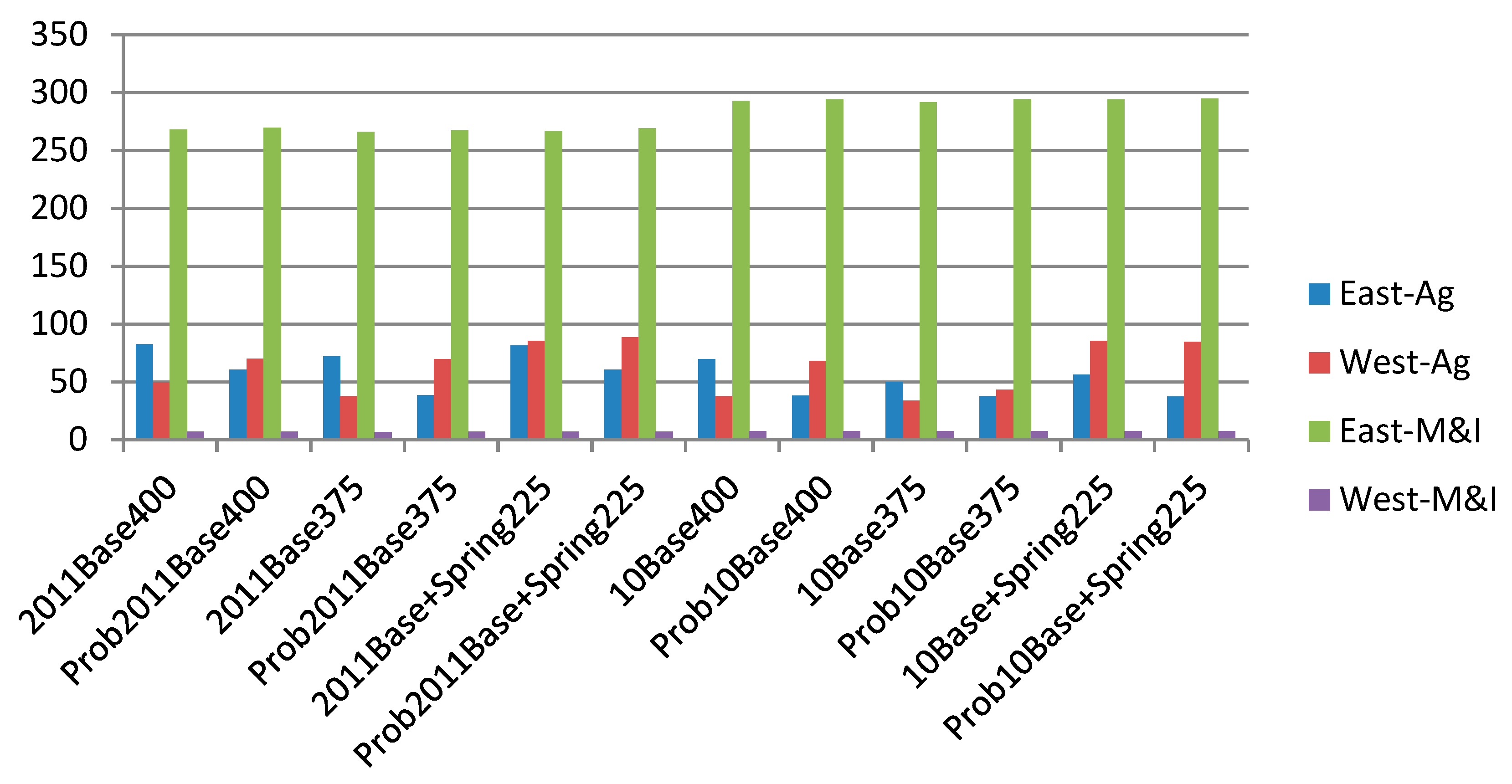
Figure three. Comparison of hydrologic impacts with and without increased drought. Notation: (i) Definitions of scenarios are provided in Table 1. (2) When the drought frequency is increased past 0.ii, each scenario is prefixed with "Prob". (3) "Comal Springflow" and "San Marcos Springflow" refer to the springflow in Comal Bound and San Marcos Leap, respectively (103 acre feet). (iv) "J17 Well" refers to the elevation of a reference well in San Antonio (feet).
Figure 3. Comparison of hydrologic impacts with and without increased drought. Note: (1) Definitions of scenarios are provided in Table 1. (2) When the drought frequency is increased past 0.2, each scenario is prefixed with "Prob". (three) "Comal Springflow" and "San Marcos Springflow" refer to the springflow in Comal Spring and San Marcos Spring, respectively (10iii acre feet). (iv) "J17 Well" refers to the elevation of a reference well in San Antonio (feet).
Tabular array i. Definition of scenarios.
Table 1. Definition of scenarios.
| Scenarios | Definition |
|---|---|
| 2011Base | Baseline |
| 2011Base400 | Base model with pumping limit of 400 thousand acre-feet |
| 2011Base375 | Base of operations model with pumping limit of 375 one thousand acre-feet |
| 2011Base+Spring225 | Base of operations model with minimum springflow of 225 cfs |
| 10Base400 | Chiliad&I water demand increases of 10% and 400 grand acre-anxiety pumping limit |
| 10Base375 | G&I water demand increases of 10% and 375 thou acre-feet pumping limit |
| 10Base+Spring225 | M&I water need increases of 10% and minimum springflow of 225 cfs |
Table 2. Recharge states, years represented, recharge level, and probability distribution.
Table 2. Recharge states, years represented, recharge level, and probability distribution.
| Recharge State | Years (1934-2011) | Recharge Level | Probability |
|---|---|---|---|
| (Typical Weather condition Years in Bold) | (103 acre-feet) | ||
| Heavily dry | 1956, 2011, 1951 | 43.seven | 0.0385 |
| Medium dry | 1954, 1953, 1963, 1948, 1934 | 170.7 | 0.0641 |
| Dry out | 1955, 1984, 1950, 2006, 2008, 2009, 1989 | 214.iv | 0.0897 |
| Dry out-normal | 1962, 1943, 1952, 1940 | 275.5 | 0.0513 |
| Normal | 1996, 1988, 1939, 1937, 1980, 1964, 1983, 1982, 1947, 1938, 1993, 1967, 1999, 1978, 1949 | 324.three | 0.1923 |
| Normal-moisture | 1945, 1995, 1994, 1946, 1942, 1944, 1969, 2000, 1966, 1965, 1974, 1970, 2003, 1959, 1961, 2005, 1972 | 658.5 | 0.2179 |
| Wet | 2010, 1960, 1941, 1968, 1976, 1936, 1971, 1977, 1975, 1985, 2001, 1979, 1990, 1997, 1998, 1957, 1986 | 894.1 | 0.2179 |
| Medium wet | 1935, 1981, 1973, 1991, 2002, 1958 | 1711.2 | 0.0769 |
| Heavily wet | 1987, 2004, 2007, 1992 | 2003.half-dozen | 0.0513 |
| Average | 710.ix |
Tabular array 3. Comparison of the welfare effect with and without increasing drought frequency.
Table 3. Comparing of the welfare effect with and without increasing drought frequency.
| Scenarios | Change in Economic Benefit (10half dozen $) | ||||
|---|---|---|---|---|---|
| Cropping | Livestock | M&I | Full Surplus | ||
| Prob(Drought) No Alter | 2011Base_Baseline | 211.75 | 54.80 | 828.41 | 1094.95 |
| 2011Base400 | −8.24 | 2.38 | −0.64 | −vi.50 | |
| 2011Base375 | −11.22 | 3.12 | −0.83 | −eight.92 | |
| 2011Base+Spring225 | −4.73 | 1.44 | −0.65 | −3.94 | |
| 10Base400 | −11.47 | iii.20 | 82.04 | 73.72 | |
| 10Base375 | −14.seventy | three.97 | 81.82 | 71.09 | |
| 10Base+Spring225 | −eight.thirteen | 2.24 | 82.twenty | 76.31 | |
| Prob(Drought) Increases 0.ii | 2011Base | −6.88 | 0.00 | 4.48 | −2.40 |
| 2011Base400 | −14.38 | 2.35 | 3.79 | −viii.25 | |
| 2011Base375 | −17.20 | iii.03 | 3.51 | −10.67 | |
| 2011Base+Spring225 | −thirteen.41 | 2.10 | 3.87 | −7.44 | |
| 10Base400 | −17.45 | 3.09 | 86.78 | 72.43 | |
| 10Base375 | −21.10 | 4.12 | 86.80 | 69.82 | |
| 10Base+Spring225 | −sixteen.55 | 2.92 | 86.98 | 73.35 | |
Table 4. Comparing of impacts on land conversion with and without increasing drought frequency.
Tabular array 4. Comparing of impacts on land conversion with and without increasing drought frequency.
| Scenarios | Modify in Country Use (x3acre-feet) | ||
|---|---|---|---|
| FurrowToGrass | SprinklerToGrass | ||
| Prob(Drought) No Change | 2011Base_Baseline | 0.00 | 0.00 |
| 2011Base400 | ten.54 | 20.65 | |
| 2011Base375 | fifteen.73 | 25.45 | |
| 2011Base+Spring225 | 0.00 | 19.47 | |
| 10Base400 | 15.73 | 26.59 | |
| 10Base375 | 17.80 | 35.27 | |
| 10Base+Spring225 | 0.00 | xxx.97 | |
| Prob(Drought) Increases 0.2 | 2011Base | 0.00 | 0.00 |
| 2011Base400 | 0.00 | 32.17 | |
| 2011Base375 | 0.00 | 41.93 | |
| 2011Base+Spring225 | 0.00 | 28.96 | |
| 10Base400 | 0.77 | 42.03 | |
| 10Base375 | 13.76 | 42.03 | |
| 10Base+Spring225 | 0.00 | xl.56 | |
Table 5. Comparison of the impacts on water employ with and without increased drought.
Tabular array 5. Comparison of the impacts on water use with and without increased drought.
| Scenarios | Alter in H2o Use (103acre-feet) | |||
|---|---|---|---|---|
| Irrigated Cropping | M&I | Total Value | ||
| Prob(Drought) No Change | 2011Base_Baseline | 224.10 | 284.90 | 509.01 |
| 2011Base400 | −91.83 | −10.34 | −102.17 | |
| 2011Base375 | −114.82 | −12.03 | −126.85 | |
| 2011Base+Spring225 | −57.55 | −eleven.04 | −68.59 | |
| 10Base400 | −117.06 | fifteen.21 | −101.85 | |
| 10Base375 | −140.71 | 13.86 | −126.85 | |
| 10Base+Spring225 | −82.90 | 16.36 | −66.55 | |
| Prob(Drought) Increases 0.ii | 2011Base | −0.30 | ane.49 | i.xviii |
| 2011Base400 | −93.99 | −8.74 | −102.73 | |
| 2011Base375 | −116.xxx | −ten.64 | −126.95 | |
| 2011Base+Spring225 | −74.98 | −8.90 | −83.88 | |
| 10Base400 | −118.14 | 16.51 | −101.63 | |
| 10Base375 | −143.37 | 16.56 | −126.81 | |
| 10Base+Spring225 | −102.36 | 17.41 | −84.95 | |
Table six. Comparing of impacts with various degrees of drought probability change.
Tabular array 6. Comparison of impacts with diverse degrees of drought probability alter.
| 2011Base400 (Baseline) | Change from Baseline | |||||
|---|---|---|---|---|---|---|
| Prob + 0.one | Prob +0.2 | Prob + 0.3 | Prob + 0.2 & Flattening pdf | |||
| Economic Benefit(10six $) | ||||||
| Cropping | 203.51 | −two.97 | −6.14 | −9.24 | −5.xxx | |
| Livestock | 57.18 | −0.nineteen | −0.03 | 0.06 | 0.08 | |
| M&I | 827.76 | two.13 | iv.43 | half-dozen.80 | 2.66 | |
| Total Surplus | 1088.45 | −ane.03 | −ane.74 | −2.38 | −2.56 | |
| Land Utilize (103acres) | ||||||
| Irrigated Land | 66.09 | 0.76 | −one.43 | −2.80 | −one.24 | |
| Dryland | 0.00 | 0.00 | 0.00 | 0.00 | 0.00 | |
| Grassland | 740.26 | −1.24 | 0.98 | 2.36 | 1.01 | |
| Water Employ (103acre-feet) | ||||||
| Irrigated Cropping | 132.275 | 0.07 | −2.16 | −4.01 | −0.37 | |
| Thousand&I | 274.563 | 0.22 | 1.61 | 3.02 | 0.55 | |
| Total Value | 406.838 | 0.thirty | −0.56 | −0.99 | 0.18 | |
| Hydrologic Effects | ||||||
| Comal Spring flow (103acre-anxiety) | 265.32 | five.37 | −20.15 | −47.93 | −45.12 | |
| San Marcos Spring flow (x3acre-feet) | 81.40 | −0.88 | −5.04 | −ix.43 | −half-dozen.51 | |
| J-17 Well Finish Top (anxiety) | 680.41 | 1.90 | −iii.32 | −nine.03 | −ix.72 | |
© 2019 by the authors. Licensee MDPI, Basel, Switzerland. This commodity is an open access commodity distributed under the terms and atmospheric condition of the Creative Commons Attribution (CC BY) license (http://creativecommons.org/licenses/past/4.0/).
guidryclanouper57.blogspot.com
Source: https://www.mdpi.com/2225-1154/8/1/2/htm
0 Response to "Drought and Food Availability in Southwest Us Peer Review"
Postar um comentário